Language
 English
 العربية
|
English
In staple fiber processing, combing is an optional process that can be used when high quality combed yarn production is required. Combing results in an improvement in yarn quality and enables the spinner to spin finer count yarns than would be possible with carded yarn.
Objectives of the combing process:
Accordingly, combed yarns are more uniform, stronger, more lustrous, compact, less hairy and cleaner than carded yarn. Combed yarn is made only of long fibers, giving a more expensive high quality yarn, since as much as 25% of fiber (almost a quarter of raw cotton) may be eliminated as short fiber waste called noils. They are used to produce stronger, smoother and more serviceable cotton products.
The combing operation is cancelled and cotton passes directly from carding to drawing and ring spinning. Therefore carded yarn is cheaper in production but of inferior quality. Carded yarns contain a higher percent of short fibers and their staple fibers are less parallel, so the yarn is weaker and more hairy, which does not enable the spinner to produce fine count yarns. Accordingly, carded yarns are used for producing inexpensive cotton fabric.
TC is the number of threads that are interlaced in a square inch of the fabric. For instance, linen of 180 TC contains 180 threads per square inch, which means that it is made of approximately 90 threads per inch in the weft (widthwise direction of fabric), and 90 threads per inch in the warp (lengthwise direction of fabric). As a result, the total number of threads in both warp and weft directions is 90 + 90 = 180, which is called TC.
Accordingly, thread count 200 TC means the presence of nearly 100 threads lengthwise and 100 threads widthwise, so TC is 100 + 100 = 200 TC. Near figures for warp and weft can also be used to reach 200 TC, for example, 120 + 80 = 200 TC.
It is important to remember that generally, the higher the thread count of a sheet, the better its quality, due to its better feel, softness, strength and longer life expectancy. Due to the importance of thread count (TC) in linens, international five-star hotel chains recommend linens of minimum 180 TC for bed sheets, and may reach up to 300 TC for patterned linen fabric, which is usually used for pillowcases and duvet covers.
Woven fabric is constructed from the interlacing of yarns woven at right angles to each other, so as to produce the structure of the woven fabric. The lengthwise yarns are called “warp” and the widthwise yarns are called “weft”.
It is a stitch produced by using one or more threads to enclose the raw edges of fabric ply or plies. Over lock stitches are used to produce a seam finish for the edge to prevent fraying, raveling or rolling of the edge.
The lengthwise sides or edges of a fabric.
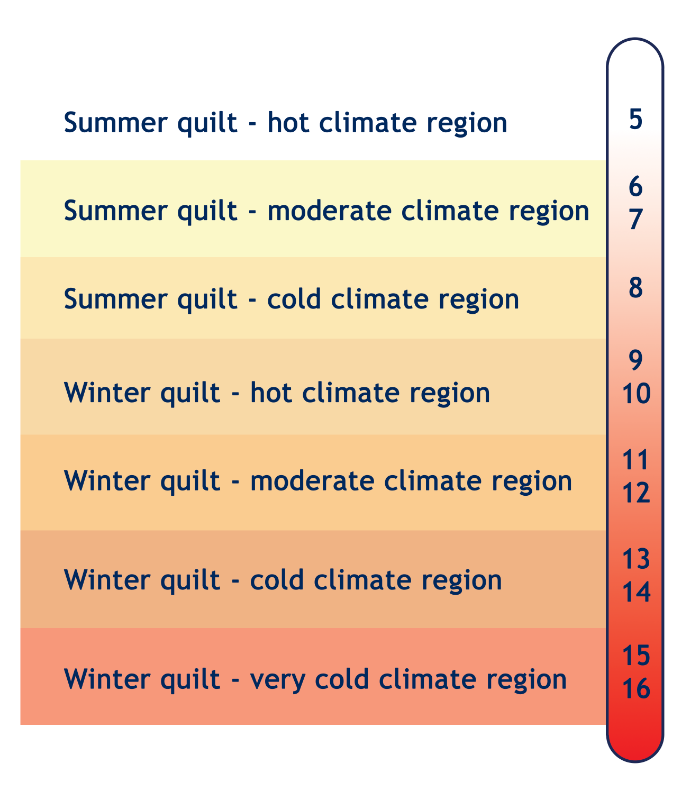
An international standard for heat insulation capacity. The higher the Tog rating on the product label, the more insulation (warmth) it will provide to your body. Add one Tog in case of using a quilt cover.
Polyester hollow fiber was introduced to the market in 1980. The cross section of this fiber has a tubular form that contains one or more holes (similar to a spaghetti shape). It gives the following advantages over solid fiber:
It is polyester fiber with a solid cross section and no holes. This was the basic raw material used for filling bedding products until hollow fiber was introduced to the market.

Login and Registration Form